Category Archives: Uncategorized

Valpak’s First Ever Hackathon, Made Possible By Agile

ab132284bcc711e2a47922000ae90d5b_7With over a year and a half into our Agile journey here at Valpak, now was the right time for our first ever hackathon.  So, hack we did!

Since we were indeed hackathon virgins, we sought advise from our sister company, Savings.com, who has been doing quarterly hackathons for quite some time now.  Being a West coast startup, they are much closer to Silicon Valley than we are, so they obviously caught the hackathon bug a lot sooner.  Our friends at Savings.com provided lots of insights from their past experiences but the most important takeaway was to make sure to “have fun”.  So, fun we had!

The Build Up

The hackathon was announced about two weeks prior to the actual event date with a quick, one-hour information session hosted by our Software Engineering Director and our Architect.  Since we sprint continuously in two week intervals around here, this allowed the Scrum teams enough advance notice to plan the event into their sprint capacity. The hackathon schedule looked something like this:

  • Thursday 3:00pm – Kick Off
  • Thursday 4:00pm through Monday 9:30am – Execution
  • Monday 9:30am – Presentations / Demonstrations / Awards

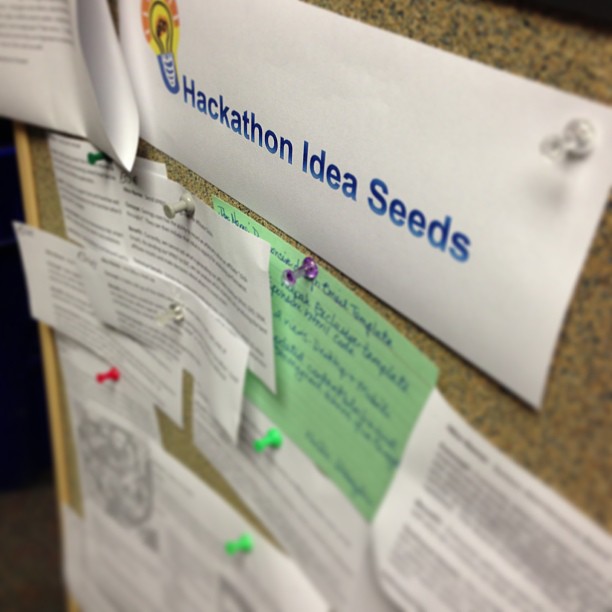
People from both the technical and business side of the house were encouraged (strictly voluntary, of course) to self-organize teams (5 person limit) around an idea of their choosing.  The only condition was that the idea be related in some way, shape, or form to a Valpak product or process.  That said, being in the business of saving people money leaves a pretty broad spectrum of ideas to be had.  A cork board was hung in a highly visible area as a seed board for ideas.  Anyone, and I mean anyone, could come up with an idea and post it to the seed board in search of other team members to hack with them or to get the attention of a team seeking an idea.   At last count, we had well over 25 ideas on the seed board (not to mention the ideas that people didn’t post because they wanted to save their thunder for the demonstration).  Teams were asked to submit their team name, idea, and team member names by the day before the kick off.  We ended up with 13 hackathon teams of 31 people comprised as follows:

  • 5 of 13 teams were one-man teams
  • 4 of 31 people were on two teams
  • 4 of 31 people were from the business side (non-IT)
  • 6 of the 13 teams worked across assigned Scrum team boundaries

The Kick Off

Coincidentally-on-purpose, we scheduled the hackathon kick off to directly follow a long-awaited IT organization cookout and kick ball game at the park.  The teams were so amp’ed up from playing kick ball in the park that the kick off was extremely spirited, to say the least.  So, kicked off we were … with kick ball!  By 3:00pm that Thursday, we all piled into our largest conference room (body odor and all) and all 13 teams got up one by one to introduce their team and describe their idea.  We had ideas running the gamut from utilities to help us save time to widgets and apps that will amaze customers to an entirely new platform architecture using up and coming technologies.

Hacking, Hacking, Hacking

Immediately following the kick off, teams began hacking away at their ideas.  So, hacking we did!  Teams had from about 4:00pm Thursday to 9:30am Monday to get as far along as possible on their ideas (teams could and did hack through the weekend if they chose too).    Teams were also able to work wherever they chose during the hackathon, office, home, a pub, wherever.  During the hacking period, the Software Engineering Director and the Architect made rounds to keep teams “unstuck” (that was another wise tip from our Savings.com pals).  Also, several of us leaders made sure that the teams were well fed and hydrated with everything from Krispy Kreme to pizzas to Red Bull and of course we had lots of leftovers from the cook out too.

Show & Tell

Monday morning rolls around and all 13 teams … Vicious & Delicious, Darth Vatr, A-Hacker, and so on … take their turn at the podium to demonstrate what they accomplished to a panel of judges and a room packed full of eager stakeholders.  The judges were the President of Cox Target Media / Valpak, the CIO (my boss), the Digital Innovation Director, and the Software Engineering Director.  The judges awarded trophies for Best Innovation, Ready For Primetime, and Nice Try.  Everyone was absolutely blown away!  All 13 ideas were viable and most teams achieved what they set out to accomplish, and in such a short time frame too.

A Look Back

As I look back on our first ever hackathon experience, I can’t help but think that so much of this was made possible by Agile … our culture, our mindset, our values.  Under the old waterfall world, we would have struggled to self-organize around a thing like a hackathon, not to mention the nightmare logistics of disrupting multiple conflicting Gantt schedules with mobs of anxious stakeholders waiting at the end of a death march.  In the old days. we were used to being told what to do by a document or by management.  Self-organization didn’t come easy to us back then.  We were waterfall zombies!  We didn’t have the capacity to dream up new ideas and we certainly didn’t have the autonomy to hack away at them.  The hackathon was our opportunity to truly practice our new found autonomy and that we did…. people picked who they worked with, what they worked on, when they worked, where they worked, and how they worked.  Oh the times they have changed!

While there are some things that we might change the next go round, like not scheduling over Mother’s Day weekend or maybe mandatory deodorant after kick ball, what we we did was hugely successful and ultimately fun too.  I, for one, can’t wait for the next one!

Agile Transformation: From The Trenches

I am very pleased to introduce guest blogger, Toby Morris, for this latest post.  Toby, known around these parts as “The Amazing Toby”, is a software developer at Valpak.  Toby has been with Valpak for many years and has had the opportunity to experience our Agile transformation from the trenches, as the title of this post suggests.  Toby gives a (sometimes brutally) honest and extremely insightful perspective on Agile.  Enjoy!

Over the past year, this blog has chronicled the Agile transformation of a company from the viewpoint of a self-professed “Agile enthusiast”. So, you have to take those posts with a grain of salt. Of course she’s going to have a relatively rosy version of things, seeing the big picture, seeing how upper management reacts to the change, seeing how the new practices is affecting the quality and quantity of product being produced. But one of Agile’s tenants is people over processes. So to truly judge the success and impact of Agile on a company, you have to get in the trenches and see how those changes are impacting the grunts. From the viewpoint of a grunt, I’m pleased with the change.

To show how things have changed, I have to tell you how they were. Just prior to our Agile transformation, we had several problems as a department. Morale was pretty low, and people were fairly unhappy with their jobs. Our department held a series of meetings to try and find the root of this dissatisfaction. After a few talks, some common themes emerged.

Most technical workers in the department had a director, a manager, and sometimes a lead. Most worked on multiple project teams, and each project team had at least one Project Manager. Each Project Manager considered their projects and tasks to be the highest priority for their teams. People were being pulled apart by competing PMs.

Another common issue was unrealistic expectations for project performance. We frequently worked on projects that were breaking new ground, but were required to make estimates that were little more than wild guesses, and we were held to them. If we “guessed” it would take six months to learn and implement a new technology, but it actually took eight or nine months, we would fail, leaving a shattered trail of disappointed business people and angry project managers.

Along with the missed deadlines, the business was becoming concerned about our ability to deliver quality products in reasonable amounts of time. We constantly ran over, and with every looming deadline, overtime pushes, sometimes all night and all weekend long, were the norm.

When the big leap was announced, there was a lot of skepticism. We were in a very sore spot, and now someone wanted to move our cheese. They actually wanted to replace our cheese with some type of healthy, new age vegetable, and we were scared. We were confused. There was a great deal of apprehension. How could we do everything we’ve been doing in a tried and true Waterfall world in short, little two-week sprints? And even if we could do it, why bother? Would it really make a difference?

Yes, it did.

We went from having multiple overseers to overseeing ourselves. We had one person determining what we’d work on, and we would decide how we did it. We broke big, multi-month projects into small, two-week stories. Some teams even broke them down smaller, opting to work in simulated one-week sprints.

It wasn’t easy to change. We all had to move, physically, to be closer to our teams. And we lost our walls. We moved into more collaborative cube setups. This provided a much more significant benefit than imagined. Sure, we could communicate readily now. No more emails or phone calls. No more standing up and walking across the room to ask a simple question. We could now turn, get the person’s attention and get our answer in seconds. Sure we could more easily collaborate. Having the developer sitting next to the QA, or the front tier, middle tier and back-end guy sitting next to each other, we could make changes and fixes in minutes rather than hours. But the real benefit is camaraderie. These people that we self-organize with become more like friends than just co-workers. A true sense of team starts up, and before you know it, you’re working together more efficiently.

We also had to learn new words and principles and practices. We learned how to effectively scrum each morning. We learned how to write user stories, and break them into actionable tasks. We even got yellow penalty flags to throw at others when they slipped up and let some waterfall back in.

We had a lot of changes.

But we got more benefit from those changes than imagined. Working in small, self-organizing teams, with a single product owner determining what we were working on for the next two weeks made all the difference. No longer did we have ambiguously ranked priorities. We knew exactly what needed to be done first, second and third. No more were we getting constant interruptions and additional tasks from various project managers. What we have to work on at the start of the sprint is what we’re working on for the whole sprint, and heaven help the person that tries to add a user story mid-sprint.

By our second sprint the business had already noticed and welcomed the new process. Instead of waiting months to see anything tangible, and to find out a project would be delayed even further for obscure, incomprehensible technical reasons, they were now seeing incremental upgrades to existing apps and new features being added to new apps on a bi-weekly basis. And even better, their feedback was incorporated into the rapidly evolving applications they depend on. They were helping to shape the tools they use.

Having a business person intimately connected to each technical team also opened the top secret technical world up and exposed our black magic. We gave our product owner an understanding of the whys and hows of software development. There were no longer the “we’re unable to do that for technical reasons”. Now, we would tell him that the protocol we’re using doesn’t support that level of encryption, and that we’d need to re-engineer the system to use a different API to achieve his needs. And that it would take another sprint to discover what that would require. And he would understand what we’re saying, why it’s causing a delay, how long the delay will be and ways to work around it. The smaller tasks and user stories mean smaller and easily recoverable failures.

Collaborative and adaptive. That’s how we work now. Morale from a technical worker standpoint has significantly improved. Our products are visibly more stable, bug-free, and valuable. Our business teams are now part of the team, and believe in our ability to make their jobs easier. We are no longer adversaries. We are agile, not hostile.


“Agile just doesn’t work for us”

I bet I grabbed your attention with that title.  Before you proceed on, please be warned that this post is definitely more of a rant.  But, if you can’t occasionally rant on your own blog, then what’s it good for anyhow?

To those that say “Agile just doesn’t work for us”, I say bullshit!  For some reason, some people think their company / organization / product is so different from the rest of the world that a process like Agile will not work for them.  When it comes to work, we are all more alike than different.  Those same people tend to look for every opportunity to blame any issue on Agile.    The team didn’t get a user story done … “Agile just doesn’t work for us”.  A stakeholder made a late change … “Agile just doesn’t work for us”.  I can’t make it to the stand-up on time … “Agile just doesn’t work for us”.  We had a bad retrospective … “Agile just doesn’t work for us”.  We deployed a bug to production … “Agile just doesn’t work for us”.  It rained today … “Agile just isn’t working for us”.  You get the point, I’m sure.

Now, don’t get me wrong … I totally get statements like “This isn’t Agile” or “We aren’t being Agile”; that, I can deal with.  Just don’t make rash statements that insinuate that the process is to blame for what is a problem that would / may exist regardless of Agile.  In other words, don’t hate the process, hate the weaknesses in ourselves that the process exacerbates … whatever it may be, lack of discipline, poor collaboration, no accountability, bad leadership, etc.

Dig deeper beyond the rash statement and you will find that often it is not the process that doesn’t work for us, but rather we don’t work for the process.  When I hear “Agile just doesn’t work for us”, I like to probe further with questions like …

  • What specifically do you think is not working about Agile?
  • What have you done to try to solve the problem?
  • Would this / did this / could this problem exist under any other process?

So, to all those that are quick to say “Agile just doesn’t work for us”, don’t be a hater.  Look within your own locus of control (never thought I’d have the opportunity to use that phrase beyond college) before you jump to judgement about a process that has worked successfully for many diverse companies all over the world for many years.


What the heck is an Agile Leadership Director?

For those that may not know, my title here at Valpak is “Agile Leadership Director”.  I have to admit … I kind of concocted it on my own after re-titling my team from “IT Project Managers” to “Agile Project Leaders” in May of last year.

  • “Agile” for my commitment to living the values and principles established by The Agile Manifesto,
  • “Leadership” because I strive to truly lead and not just manage,
  • And, “Director” because that is the level I have attained within my organization.

I’ve been told more than once that my title is “interesting” or “unique”.  In fact, the last time I Googled it, I couldn’t find the same title anywhere else in the universe.  Ultimately, the combination of me as Agile Leadership Director serving a team of Agile Project Leaders makes us the … drum roll please … Agile Leadership Office.  That’s right … my own translation of the Agile PMO.  I think it has a nice ring to it. Maybe it will catch on.

So, what the heck is an Agile Leadership Director anyhow?  I figured it was time to share my job description with the world.  I hope you will find it useful as you evolve your own Agile implementation or help others along the way.

JOB DESCRIPTION:  AGILE LEADERSHIP DIRECTOR

Summary: 

Championing, governing, scaling, and measuring the Agile framework within IT and across the enterprise.  Oversees Agile Project Leaders in the roles of ScrumMaster, Kanban Lead, and/or Project Manager.  With consideration for the Agile values and principles, the focus of this leadership position is on delivering value over meeting constraints, leading teams over managing tasks, and adapting to change over conforming to plans.

Essential Duties and Responsibilities:

  1. Develop and grow team of “Agile Project Leaders” through training, mentoring, and coaching while also supplementing staff in that role as needed.
  2. Serve in the role of “Agile Coach” through championing, training, and mentoring across the organization.
  3. Embrace and evangelize Agile values and principles across the organization and in the community.
  4. Monitor project/team performance through quantitative and qualitative measures of value, outcome, velocity, morale, and satisfaction.
  5. Develop, implement, and promote Agile best practice standards including the use of boards and tools where appropriate.
  6. Coordinate between and among Agile teams for progress and impediments via Scrum of Scrums and project management oversight.
  7. Collaborates with executive leadership team on portfolio governance for Scrum, Kanban, and other projects and facilitates the start or stop of teams based on investment decisions.
  8. Facilitates organizational learning, change management, and process adoption of Agile via metrics, benefits realization, outcomes, and retrospective findings.
  9. Performs related work and additional duties as needed or required.

 Qualifications:

  • Strong leader with integrity and business acumen
  • Strong analytical and problem solving skills
  • Detail-oriented and highly organized
  • Strong presentation and communication skills
  • Self-motivated driver and visionary able to make progress despite obstacles
  • Strong servant leader able to lead and work with multiple diverse roles and personalities
  • One or more related certifications such as Project Management Professional (PMP), PMI-Agile Certified Practitioner (PMI-ACP), or Certified ScrumMaster (CSM) required.

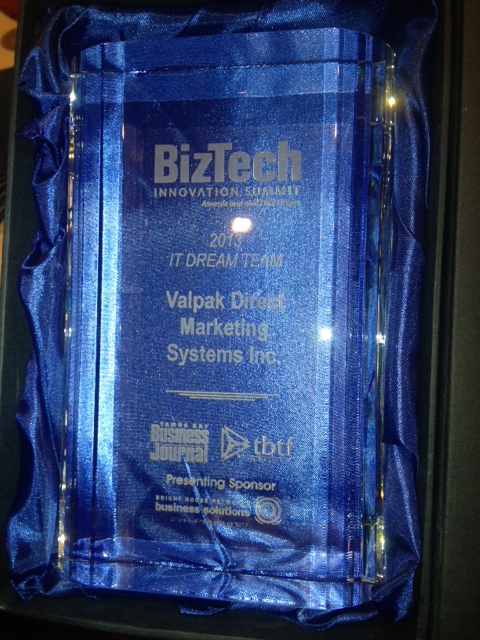
Valpak Wins “IT Dream Team” Award At 2013 BizTech

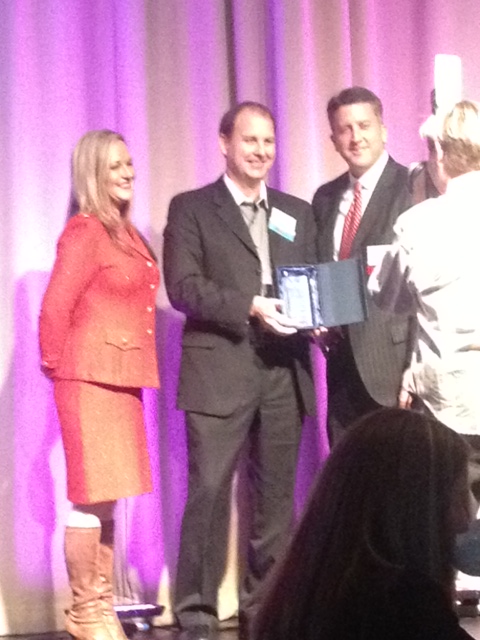
Congratulations to Valpak on winning the “IT Dream Team” award at the 2013 BizTech Innovation Summit.  I like to think that goin’ Agile had a lot to do with it.  I am so proud to work with such a great group of people.

Chris Cate, CIO, accepting the award.

Chris Cate, CIO, accepting the award.

The trophy for "IT Dream Team".

The trophy for “IT Dream Team”.


Valpak Mentioned In Dean Leffingwell’s Scaled Agile Framework Blog

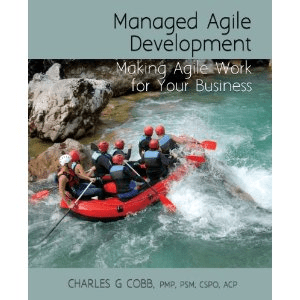
Valpak just caught the attention of Dean Leffingwell, Agile guru and father of SAFe (the Scaled Agile Framework that we have adopted).  Over the weekend, he posted a blog reviewing the “Managed Agile Development: Making Agile Work for Your Business” book that contains our Agile transformation case study.  He refers to our case study as “interesting”.  This is kind of a big deal … to me, at least.

http://scaledagileframework.com/new-agile-book-with-safe-valpak-case-study/

The SAFe website sees over 80,000 page views by 10,000 unique visitors per month. It will also be posted to Dean’s personal blog and appear on a new permanent Case Study page at the SAFe web site.


The Sprint Review Rut

After a full year of back-to-back sprinting  here at Valpak , the teams fell into a Sprint Review rut.  It’s my job to coach, inspire and motivate them right out of that rut.  So, here’s the approach I took …

As we head into our 25th Sprint Review tomorrow, I realize that it may feel like Groundhogs Day for some.  With that mindset, I think we may have fallen into a rut.  The last few Sprint Reviews have had some noticeable issues (not just noticed by me, but by our stakeholders) … team members arriving late, awkward hand-offs between presenters, dead air due to apparent lack of preparation, etc.

That said, I’d like for us to be thinking about the Sprint Reviews a little differently going forward.  Let’s all channel our inner entrepreneur and think of our team as our own company and our stakeholders as our clients.  So, you are presenting to your clients and you want them to renew/continue their contract with you for another sprint.  This is precisely what companies like AgileThought go through with each Sprint Review and we can learn a lot from them.  Remember, your team is your company, your stakeholders are your clients, and you want your clients to continue to do business with you.  With that kind of mindset you are sure to deliver a successful Sprint Review each and every time.

But, it didn’t end there.  Our Agile Coach, Ryan Dorrell (CTO of AgileThought) provided more words of wisdom …

25 Sprint Reviews?  Wow – congratulations again!

But you’ve done this meeting 25 times now…is it getting boring?  Is it getting old?  Feeling stale?  Feeling like the same thing over and over and over?

Let me tell you the story of what I’m working on right now.   About half my time right now is spent working on a project for a client where we are building two mobile apps for the – one iOS, one Android.  We have a sprint review meetings every two weeks.  The product owner sees the builds all throughout the sprint – he downloads regular builds, gives feedback, and we’ve worked with him to define acceptance criteria.   There should be no surprises.  But yet I’m always a little anxious about sprint reviews.  I want it to go well.  I want the product owner to say “wow, this is really awesome – amazing work” at the end of the review.   I want to exceed his expectations, even when we’ve been setting his expectations all sprint with complete transparency.  He knows what the product looks like, and knows what he’s going to see.  My anxiety is probably based on the fact that he’s our customer – his company pays good money to hire us to do work for them.  They don’t have to use AgileThought as a development firm.  It’s our teams job to have there be no doubt that they should use anyone else.

Compare that situation and mindset to the one you may be in.   In an internally focused role, it’s very easy to fall into the trap of not seeing your internal business customers and stakeholders as actual customers.  It’s easy to think of them as just other employees that work with.  It’s easy to miss the fact that for each team, for each sprint, there are significant dollar costs.  Customers, even internal ones, need value for the dollar.  To echo Stephanie’s point, I want you to see your customer (product owner) as the customer whose expectations you need to exceed.  Have the mindset that your product owner could go find another team to do the work that you are doing.  Maybe they can find someone who can do it faster or better or cheaper.    If there was a chance that, after each sprint, the product owner would decide whether or not to keep using your team…would that change your mindset?   Product owners are partners but also customers with the team – we owe it to them as customers to treat them as if they have a choice.  They very well might have a choice and you might not be aware of that (I’ve seen this happen).   In your next sprint review, if you aren’t a little nervous – I would ask yourself why.

If you to have fallen into a rut when it comes to your Sprint Reviews, consider this way of thinking to up your game.


Must be good. We’re in a book!

Managed Agile Development book coverIt’s been just over 16 months since we — that is Valpak’s Information Technology & Support Services (ITSS) organization — underwent a massive transformation to an Agile software development culture using Scrum and Kanban methodologies.  And, I’m proud to say that our scaling of Agile across 70+ people with (currently) 10 Scrum teams and 3 Kanban teams is considered a successful implementation of Dean Leffingwell’s Scaled Agile Framework (SAFe).  It must be good.  We’re in a book!  That’s right.  We are featured as a case study in a newly published book by Charles G. Cobb, “Managed Agile Development: Making Agile Work For Your Business”.  Charles heard about Valpak’s Agile transformation through my blog and asked that we contribute our story to the book.  The book is now available for sale at Amazon and Charles will be presenting a synopsis of the book to the Tampa Bay Agile Meetup group in April at the Valpak Manufacturing Center.


Yes, we work with an Agile coach

The more popular this blog gets, the more calls I get from Agile consulting companies wanting to “help”.  That’s sweet and all, but we already work with an Agile coach here in Tampa Bay.  Since 2011, we’ve partnered with AgileThought.  They have “Agile” in their name so they must know what they’re doing!  But seriously, we’ve got their CTO, Ryan Dorrell, as our Agile coach.  He has the best bedside manner we could have hoped for and is always the voice of reason on all things Agile.  And, Ryan will forever be my Agile phone-a-friend.  Our arrangement consisted of customized training, coaching, and strategic guidance, among other things.  In fact, our relationship has been so successful that we are submitting for a local collaboration award as we speak.  Wish us luck!

Now that that is cleared up, I do want to take a moment to express the importance of having an external / independent Agile Coach to assist and guide your transformation.  Attempting to DIY (Do It Yourself) Agile can sometimes backfire.  In my experience, money spent on an Agile coach is definitely money well spent!  You need to spend the money to bring on an Agile coach for at least 6-months to train the teams and support the process. As human beings, we can laugh about the notion that we are more willing to take advice from a stranger than from a family member.  This is true in the business world as well (and that’s why consulting is big business).  Companies often tend to appreciate the advice of an independent expert more than a trusted member of the company’s own staff.  Also, an Agile coach can really have your back when it comes to resistance at any level.

Now, where I could use some help is if you are an Agile speaker and plan to be in the Tampa Bay area.  The Tampa Bay Agile Meetup group is always in need of speakers.  It might just be your way of reaching other companies that do indeed help with their Agile transformation.  Leave a comment if that opportunity interests you.


I’m Agile! Now what?

We here at Valpak are 1 year and 3 months into our Agile journey (not a destination, but a journey indeed).  We’ve transformed and scaled from 6 Scrum teams and 4 Kanban teams (October 2011 was Sprint 1) to 10 Scrum teams, 3 Kanban teams, and all the elements that comprise the Scaled Agile Framework (SAFe) including a release train, a Portfolio Kanban, and an Architecture Kanban. We’ve even got business, project, and personal Kanban boards popping up left and right.  And if that wasn’t enough, we’ve produced a video on our Agile Transformation and are just about to have a case study published in a book.  Plus, all along the way I’ve been blogging about our transformation.  So, that leads me to ask, “I’m Agile! Now what?”

In the 1+ year we’ve been doing Agile, we’ve managed to become very good at some of the basics … sprint planning, stand-ups, retrospectives, etc.  Teams go through the motions of Scrum in a lather-rinse-repeat fashion sprint after sprint after sprint.  We are doing Agile!  Now we need to be Agile!  To me, truly being Agile involves the conscious embrace of the Agile mindset such that it becomes deeply intertwined within our culture, values, and beliefs as a company and in everything we do each and every day; all the problem solving, creating, decision making, innovating, and direction setting that goes into running and growing the business.

So now that we are Agile, we keep on keepin’ on … that means we keep sprinting! It’s pretty clear that never ends.  While we continue to sprint merrily along, I continue to support and grow Agile across the organization as Director of Agile Leadership.  With that in mind,  I’ve outlined some 2013 goals for us that are specific to where we are at in our transformations and journey:

  1. My team of Agile Project Leaders, as well as some other interested folk, will pursue the PMI-ACP (Project Management Institute – Agile Certified Practitioner) this year.  This means there will be more than just me with a relevant certification in hand.  We can debate the value / need of certifications all you want, but it most certainly represents a commitment to Agile here at Valpak.
  2. We will further scale the process and teams to support the needs of the business.  This might mean starting teams, stopping teams, merging teams, or re-assigning team members.  Again, all based on the needs of the business throughout 2013.
  3. With 1+ years under their belts, all of the ScrumMasters (titled “Agile Project Leaders”) will truly step into the role of Agile coach, embodying the Agile mindset and, not just facilitating, but coaching teams too.
  4. By continually improving our estimating and planning, all teams will become more and more predictable over time by their velocity and story points will become second nature to our teams.
  5. We will become masters at (okay, maybe not masters, but at least really good at) writing user stories.  We will decompose stories just right and write meaningful (maybe even measurable) “so that” statements.
  6. Our backlogs will be so well groomed that each team will have 2 to 3 sprints worth of stories penciled in and priorities will be evident by the order of the stories in the backlog.
  7. We will send a handful of our best and brightest to the Agile 2013 conference to develop and network in hopes that they will return to further evangelize Agile across the organization.
  8. Teams will strive to become high performing teams by not just doing Agile but being Agile.
  9. We will give back to the Agile community by sharing our story with anyone willing to listen and encouraging others in their Agile transformation.